

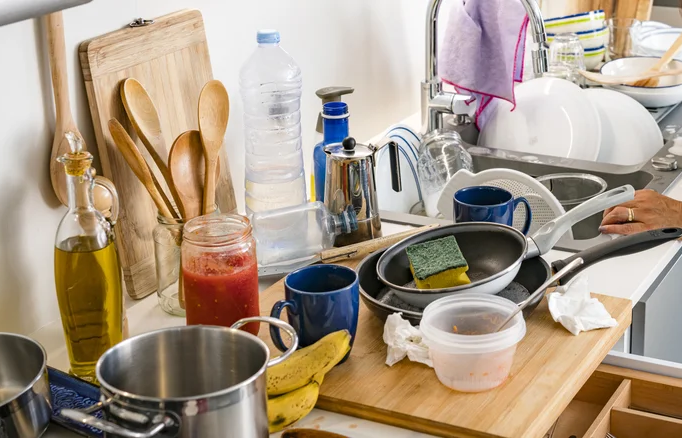
In the modern domestic imagination, few spaces carry as much symbolic weight as the kitchen countertop. It is the stage upon which the rituals of nourishment, hospitality, and family life are performed. It is also, according to a vast corpus of lifestyle media, a moral battleground—a flat plane where the state of one’s soul is made manifest through objects. A cluttered counter signifies a cluttered mind; a clear one, serene mastery.
Content titled “Declutter Your Countertop with These Smart Amazon Finds | From Chaos to Calm” operates squarely within this moral and therapeutic framework. It is not merely shopping advice; it is a promise of personal transformation. It diagnoses a condition (“chaos”) and prescribes a retail-based cure (“smart finds”) to achieve a desired state of being (“calm”). This genre has flourished in the age of social media, where the countertop is no longer a private workspace but a public-facing backdrop, scrutinized in video calls and curated for Instagram. This review will dissect this promise, peeling back the layers of marketing rhetoric to examine the engineered solutions, their unintended consequences, and the deeper cultural longings they seek to satisfy. We ask: does this path from chaos to calm lead to genuine liberation, or does it simply exchange one form of anxiety for another?
2. Deconstructing “Chaos”: The Pathologization of Domestic Life
The first step in the genre’s narrative is the establishment of “chaos” as a problem requiring intervention. This is not chaos in the catastrophic sense, but an aesthetic and functional condition defined by the visible presence of everyday objects: the toaster, the coffee maker, a knife block, a fruit bowl, a stack of mail. This “chaos” is framed through specific, emotionally charged language:
-
Visual Noise: The assemblage of differently shaped, colored, and branded items is described as “noisy,” “busy,” or “jarring,” implying a sensory assault that must be quieted.
-
Cognitive Load: Clutter is said to “weigh on the mind,” stealing focus and mental energy. The clear countertop, by contrast, promises “mental clarity” and “room to think.”
-
Moral Failing: Implicitly, a cluttered counter can read as a lack of discipline, poor time management, or an inability to “adult” properly. Decluttering becomes an act of virtuous self-correction.
This framing is profoundly effective because it taps into genuine feelings of overwhelm in fast-paced lives. However, it also pathologizes the normal state of a working kitchen. It suggests that the evidence of life—of breakfast rushed, of projects undertaken, of groceries purchased—is itself a problem to be solved, rather than the natural byproduct of inhabiting a space. The “chaos” is often the chaos of living, and the proposed cure is its visual erasure.
3. The Taxonomy of “Smart Finds”: The Tools of Erasure and Concealment
The proposed solutions in these articles are rarely about removing items from the home; they are about managing their visibility. The “smart find” is clever because it helps hide the evidence of domesticity. These products generally fall into three strategic categories:
Category 1: The Verticalizers (The “Look Up!” Solution)
These products aim to reclaim horizontal square footage by leveraging vertical air space.
-
Examples: Tiered fruit and vegetable stands, multi-level spice racks, wall-mounted knife strips or magnetic bars, shelf risers for inside cabinets that allow small appliances to be stored below.
-
The Promise: Efficient use of “wasted” air space, keeping essentials accessible but off the prime counter real estate.
-
The Critical Analysis: Verticalization doesn’t reduce object count; it creates a skyline of clutter. It can make items harder to reach (the back of a tiered stand) and turns functional tools into a display, often creating a denser, more complex visual field. It simply changes the plane of the chaos from horizontal to vertical.
Category 2: The Concealers (The “Now You Don’t See It” Solution)
This is the most psychologically potent category, offering the magic trick of disappearance.
-
Examples: Sliding or tambour-door “appliance garages,” decorative bread boxes with lids, stylish canisters for utensil storage, catch-all trays or “landing strips” that corral small items into a single, intentional rectangle.
-
The Promise: The instantaneous transformation from messy to minimalist. The clutter is not gone, but it is contained within a singular, aesthetically pleasing form. The container provides a visual rest stop, creating the illusion of emptiness.
-
The Critical Analysis: Concealment creates a dual reality: a pristine public face and a hidden, often jumbled, private interior. It adds steps to daily use (opening a door, lifting a lid) and can make items easier to forget. The “calm” of the concealed kitchen is performative, existing only when the doors are closed and the lids are on. It also requires a new layer of maintenance: organizing the inside of the concealer.
Category 3: The Displacers (The “Out of Sight, Out of Mind” Solution)
These finds encourage moving countertop items elsewhere entirely.
-
Examples: Over-the-cabinet hooks for mugs, under-cabinet mounts for paper towels or aluminum foil, in-drawer knife blocks and appliance caddies, freestanding pantry cabinets.
-
The Promise: True liberation of the countertop surface. By finding a “home” for everything in cabinets, drawers, or on walls, the counter becomes a blank, functional canvas.
-
The Critical Analysis: Displacement solves the countertop problem by exacerbating storage problems elsewhere. It fills drawers with bulky items, crowds cabinets, and can make frequently used tools less accessible. The effort required to retrieve and replace a heavy mixer from a deep cabinet may mean it is used less, or worse, left out, recreating the original “chaos.” It treats the symptom (objects on the counter) without addressing the cause (inadequate or poorly planned storage for daily essentials).
4. The “Calm” Paradox: The New Anxieties of Curated Emptiness
The promised destination of this journey is “calm.” But the calm achieved through these “smart finds” is a specific, fragile, and often costly construct.
A. The Calm of Performance: This calm exists for an audience, whether real or imagined. It is the calm of a stage set between scenes. It is maintained through constant vigilance—the immediate washing and putting away of the coffee cup, the swift return of the knife to its magnetic strip, the closing of the appliance garage door. This performance requires continuous labor, transforming the kitchen from a space of creative making into a site of relentless tidying.
B. The Calm of Conformity: The aesthetic promoted is invariably one of muted tones, natural materials, and geometric simplicity. To achieve this calm, one must often discard or hide the colorful, the sentimental, the quirky, or the inherited—the very items that may bring personal joy. The calm is achieved through aesthetic homogenization, creating kitchens that look eerily similar, as if furnished from a single, global, algorithmically-determined catalog.
C. The Calm of Fragility: This curated calm is easily disrupted. A single child’s art project, a grocery bag waiting to be unpacked, or a non-conforming appliance (a bright red stand mixer in a beige-and-wood scheme) can shatter the illusion. The system’s rigidity means it cannot absorb the organic mess of real life, creating fragility anxiety—a low-grade stress about maintaining the perfected state.
D. The Economic Cost of Calm: Achieving this look requires significant investment in the organizational infrastructure itself. The “smart finds”—the ceramic canisters, the walnut knife block, the custom drawer inserts—are not free. The pursuit of visual calm becomes a consumer project, where peace is purchased piece by piece, often from the same platform (Amazon) that delivers the clutter of modern life in brown boxes.
5. Toward an Ethic of Functional Authenticity
If the “chaos to calm” model is flawed, what constitutes a healthier relationship with our countertops? The answer lies in shifting from a paradigm of concealment and performance to one of intentional function and authentic use.
-
Conduct a “Use-Frequency” Audit: Objectively assess what needs to be on your counter. The “First-Order Tools” principle suggests that any item used daily or near-daily earns its place. This is less about hiding the coffee maker and more about accepting it as a rightful, functional resident. An item used weekly or monthly should be stored accessibly but out of the prime workspace.
-
Embrace “Positive” Clutter: Distinguish between chaos (a disordered pile of unrelated, unused items) and activity (the evidence of legitimate, ongoing life). A bowl of fruit, a beautiful cutting board left out, a favorite ceramic jar for wooden spoons—these are signs of a kitchen that is alive and loved. They provide visual warmth and human scale.
-
Optimize for Workflow, Not Photography: Arrange your countertop based on cooking ergonomics (the “kitchen triangle” concept applied to small zones). Place items where they are used, creating efficient stations for coffee, prep, and cleaning. A functional layout that reduces steps will create more genuine calm during cooking than a sterile layout that is photographable.
-
Invest in Inherently Beautiful Tools: Instead of buying a container to hide ugly tools, gradually replace the ugly tools with well-designed, aesthetically pleasing ones that you are happy to see. A good chef’s knife, a sleek kettle, or a quality toaster can be objects of beauty and function that contribute to, rather than detract from, the space.
-
Practice “Closed-Counter” Time: Designate times, perhaps after cleaning up from dinner, when the counter is cleared and wiped, achieving that visual “calm” as a periodic, intentional reset rather than a constant state. This allows the kitchen to be a dynamic workspace by day and a serene space by night, accepting the natural rhythm of use.
6. Conclusion: Reclaiming the Countertop from the Algorithm
“Declutter Your Countertop with These Smart Amazon Finds | From Chaos to Calm” is a powerful cultural script that sells a potent fantasy: that inner peace can be purchased and arranged on a quartz surface. It provides tactical solutions for genuine spatial constraints, and a well-chosen organizer can improve daily life. However, as a holistic philosophy, it is ultimately a prescription for discontent, pathologizing the lived-in home and monetizing the anxiety it inflames.
The true decluttering project is not for the countertop, but for the mind. It involves questioning the imported ideals of domestic perfection, resisting the urge to perform serenity for an invisible audience, and rejecting the notion that a clear surface is synonymous with a clear conscience. The calm we seek will not be found in a clever container from Amazon, but in the permission to let our kitchens be real, functional, and uniquely ours—marked not by the absence of things, but by the presence of a life being lived, fully and messily, within them. The most revolutionary “smart find” is the wisdom to know that sometimes, the best use of a countertop is to let it hold the beautiful, necessary evidence of your day.